






Klaus and Gottfried Hoffmann explain: "We had been looking into CNC for quite some time, but it never really clicked." A compact and robust solution was needed, and they add: "A five-axis CNC was simply too large and too expensive for us." A lightbulb moment at Ligna Hannover put the two entrepreneurs on a promising track and, above all, led to completely new ideas.
A Strong Player in Commercial Projects
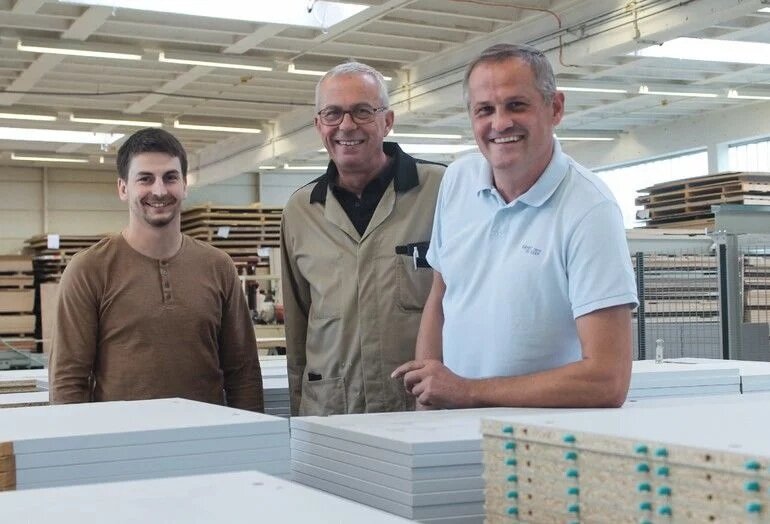
GH-Möbeltischlerei, Hoffmann & Söhne GmbH in Eisenstadt is a second-generation business. Since 1990, brothers Ing. Klaus Hoffmann (pictured right) and master joiner Gottfried Hoffmann (center) have been running the family business, which now has 20 employees. The commercial sector, working with public and private developers as well as architects, is the main source of revenue, accounting for around 60%. This primarily involves furnishings for offices, hotels, and nursing homes. Private customers are served with residential furniture, kitchens, doors, and custom interior fittings. The Eisenstadt-based joinery often generates significant follow-up orders from its small showroom for upholstered furniture and beds.
Without Consoles and Vacuum Pods
During their CNC research at Ligna, the Hoffmann brothers found their views confirmed: "Positioning consoles and vacuum pods, with the laborious manual clamping of often heavy workpieces, was definitively ruled out," explains Gottfried Hoffmann. At the Felder Group booth, it apparently became clear very quickly: "The concept of the universal throughfeed CNC, the Creator 950 from Format 4, where the workpiece is fed horizontally into the machine for processing, was tailor-made for us." Furthermore, the Creator 950 also proved to be the ideal CNC for cabinet construction.
On the Path to Automation
But the two entrepreneurs wanted more. Klaus Hoffmann: "When it comes to cabinet processing, we're dealing with higher volumes. Batch sizes of 200 parts are not uncommon." Given this requirement, the step towards automated loading and stacking was not far off. However, "A robot would have far exceeded our investment budget," they say in Eisenstadt. In close collaboration with the experts from Felder, the idea, dubbed the "ghost shift," was intensively developed and ultimately implemented by the Felder Group with new concepts and some clever details.
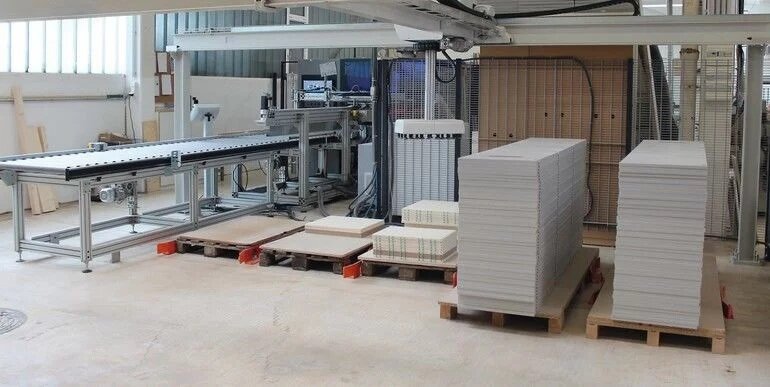
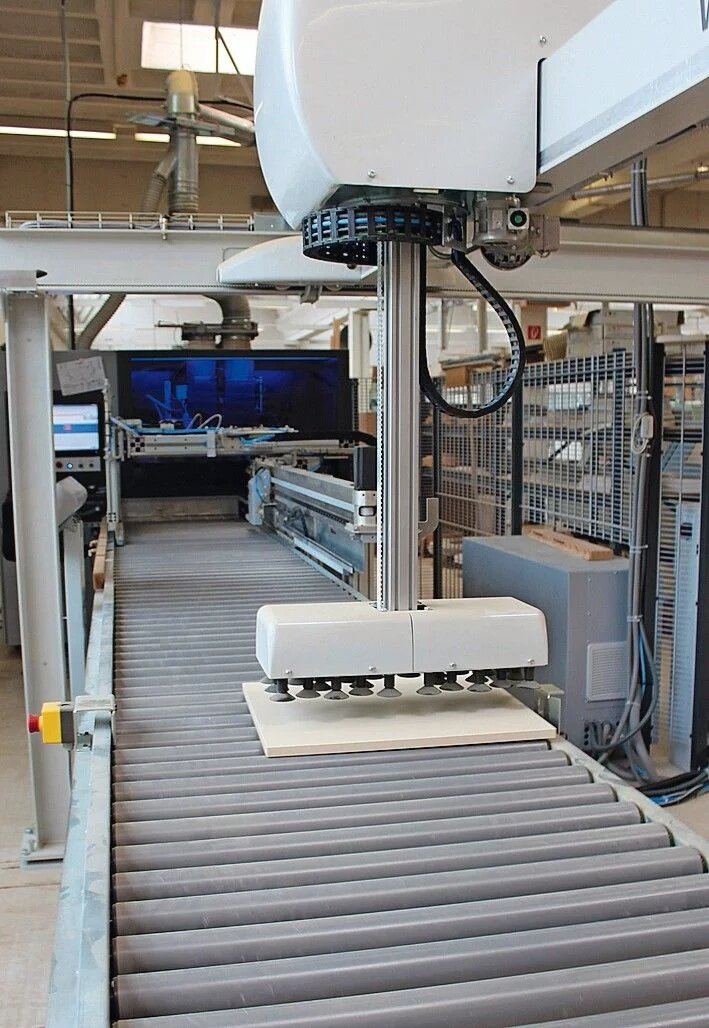
The automation solution at Hoffmann consists of a combination of a gantry loading and stacking system with a vacuum manipulator from Barbaric and a powered roller conveyor for feeding and returning the parts. The Creator 950 offered a key prerequisite for this: it not only operates in a full throughfeed mode but also optionally in reverse mode. After CNC processing, the parts can be transported back to the infeed side. This principle allows for loading and stacking at the front of the machine. After calling up the processing programs in the CNC's Woodflash control system and making a few entries at the loading and stacking system's terminal, the fully automated process can begin. A completely autonomous operation with an integrated barcode scanner was not relevant due to the production of identical parts in high volumes, but it would have been equally possible.
A crucial element on the throughfeed CNC is the solution for precise workpiece positioning against the stops at the machine infeed, achieved through special longitudinal and lateral aligners. Klaus Hoffmann sees his vision realized in this key feature and reports a very constructive collaboration with the Felder Group: "We are proud that we were able to contribute our ideas."
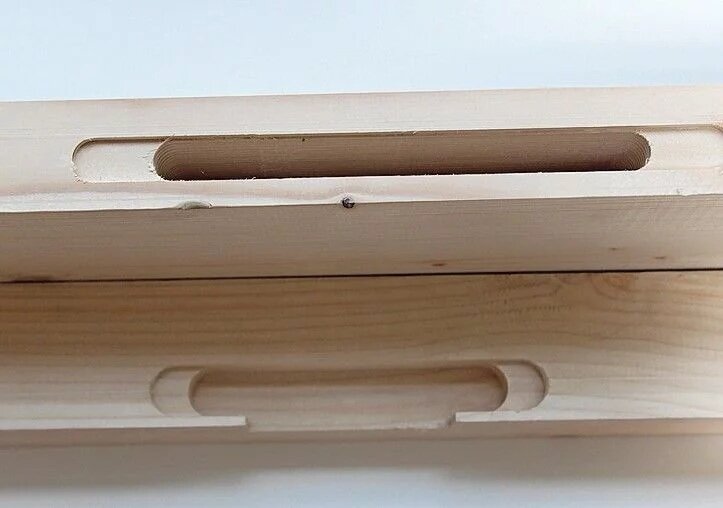
The Creator 950 itself requires only about 5 m² of floor space and can process parts from 6 to 80 mm in thickness, up to 950 mm in width, and approx. 4000 mm in length. The machine can be equipped with a 12 kW main spindle, and the drilling head can have up to 25 drilling spindles. Additionally, there is a 4-position tool changer and a pick-up station for an exchangeable angle head. Complete processing also includes milling on the face and edges for the Lamello Clamex connector. Another highlight is the parametric programming with a graphical user interface. Standard parts are pre-stored and can be easily modified. At Hoffmann, the Creator 950 is used not only for series production of cabinet parts but also for a wide range of universal applications. The broad spectrum of applications ranges from doors and block frames to cut-out frame components and curved shaped parts.
Water Instead of Glue
For dowel insertion on the Creator and the often-critical gluing process, the Hoffmann brothers discovered another practical solution after much experimentation. Dowels with a reactive PUR coating solve the problem of gluing the dowel holes. Instead of glue, only a defined amount of water is injected into the dowel holes. The PUR coating reacts with the moisture and ensures a secure bond for the dowels. Klaus Hoffmann greatly appreciates this: "There is no contamination from glue residue on the machine, and the entire cleaning process for the dowel station is eliminated."
Producing After Hours
The investment is clearly paying off for the Eisenstadt joinery in more ways than one. Compared to the previous step-by-step production on individual machines, they comment, the automated complete CNC processing has allowed them to save labor time equivalent to about two skilled workers.
Klaus and Gottfried Hoffmann are genuinely enthusiastic about the realization of their "ghost shift" idea: "With four to nine stacking positions (Euro-pallets) and depending on the workpiece size and the required CNC processing, the system runs completely autonomously for up to 12 hours—including, of course, after regular working hours." Klaus Hoffmann makes sure to point out the potential reserves in the implemented concept. For example, with a second handling gantry behind the Creator, the throughput could be significantly increased.


