
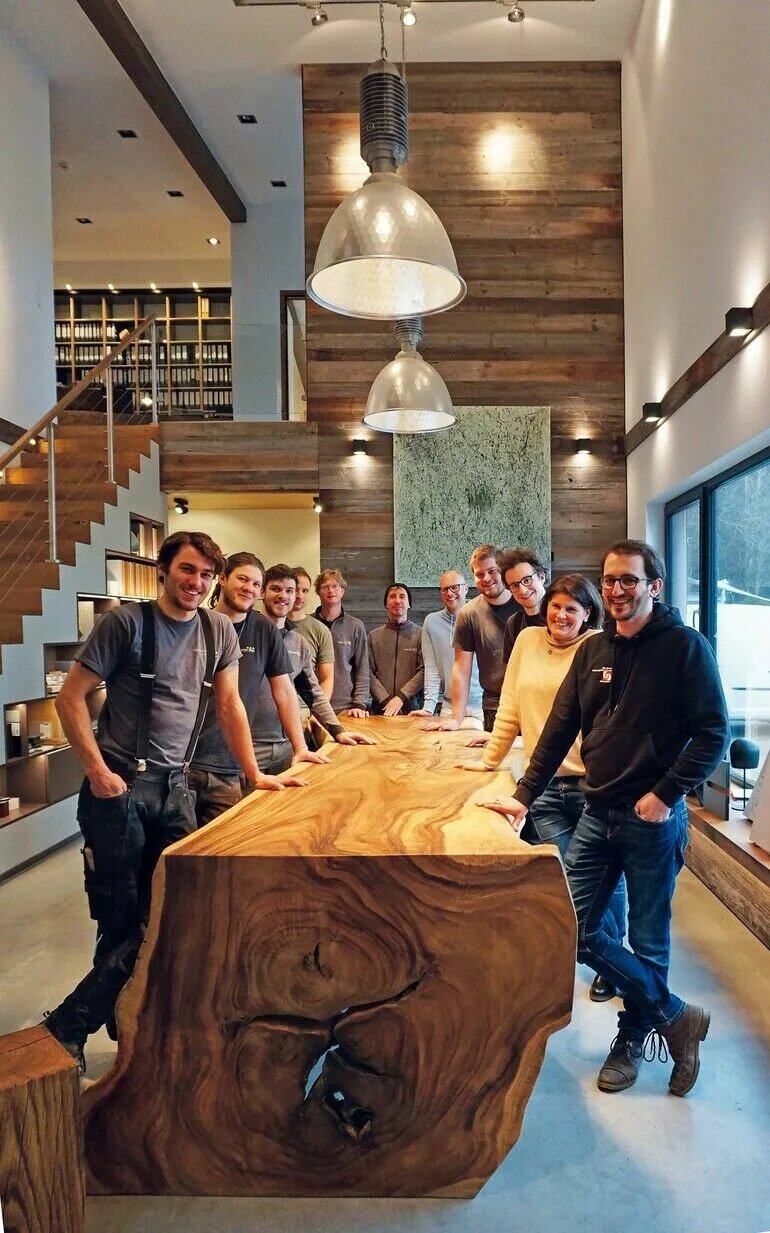
I am standing on the grounds of an old construction yard with an attached residence. This is where I am meeting Andreas Greive today. It's surrounded by greenery, located in the town of Stephanskirchen, a 15-minute drive from Rosenheim, close to the mountains and Lake Chiemsee. The kind of place I would go for a vacation. Anton Herzinger, 53, one of the owners of Herzinger and Greive Design, has called this place home since his childhood. His father was a building contractor and, in the 1980s, had around 200 employees at this very location. When the company had to close, the hall stood empty for a time, until Herzinger started his own business as a cabinetmaker in 1996 with just a jigsaw and a cordless drill.
A Meeting of a Lifetime
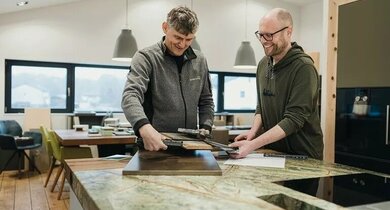
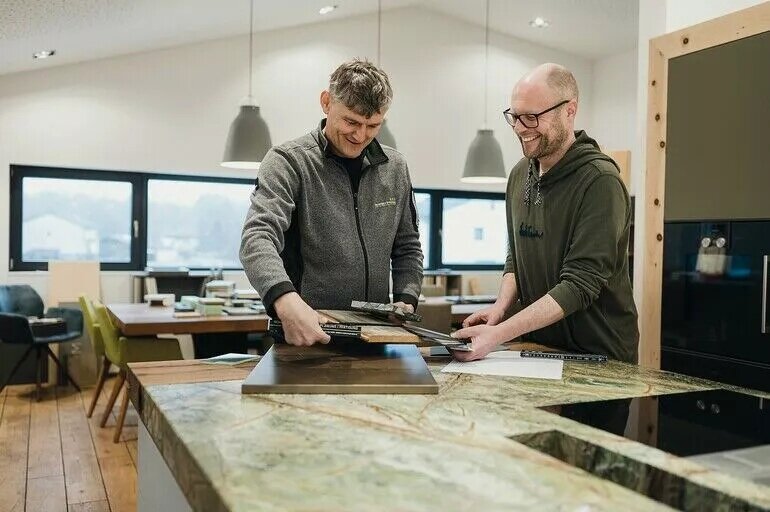
Then, in 2001, came the encounter that would change everything. As a wood technology student, Andreas Greive, 42, moved from the Münsterland region to Rosenheim. To earn some money, he began working for Anton Herzinger alongside his studies. Gradually, in between customer projects, they expanded the workshop, because space was tight everywhere. "We used to do our finishing under the lean-to roof, and the circular saw was also outside," Greive recalls. After two years of studying wood technology, Andreas Greive switched to interior architecture. Now a graduate engineer, he quickly realized that he was more drawn to the interplay of forms and the spatial effects created by different materials than to the purely technical side of wood processing and machining. "That's Toni's part in our collaboration," Greive emphasizes. Anton Herzinger is not only a trained cabinetmaker but also a state-certified wood technician.
Two Companies Become One
In 2007, Andreas Greive started his own business as a designer and interior architect. "With Toni's cabinetmaking shop as a partner. And conversely, Toni had me on hand as a designer for his clients," Greive explains the situation at the time. Their joint, fruitful collaboration blossomed into a deep friendship. Over time, the volume of orders increased, and so the premises had to be expanded. "We had a hotel renovation project coming up. That's when we enlarged the workshop and also purchased our first CNC," recounts the graduate engineer in interior architecture (FH). It was a 5-axis Homag Venture 16L. Herzinger and Greive existed side by side and together for almost ten years. Then, in 2016, came the decision to join forces as a single company. "It was an important step towards greater transparency, both for our clients and for us," Greive explains.
Expansion and a Second CNC
In 2015, shortly before the new company was founded, a building extension was added. The total area of the business is now approximately 3,000 m². In addition to the entire office wing and meeting rooms, the extension also houses part of the production facility. Alongside a vacuum press, a horizontal panel saw, and an edgebander, this is where the second CNC is located: a 5-axis Homag BMG 311 Venture. The purchase in 2016 was an emergency solution. "Our machining center had suffered a total failure and needed extensive repairs. To keep production running, we spontaneously bought a CNC that was immediately available," says Nino, who spends a lot of time working on this machine.
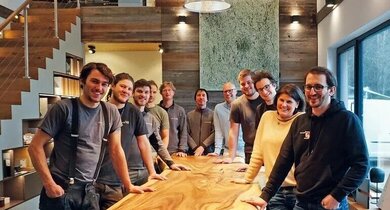
Journeyman Nino, master cabinetmaker Patrick, and technician Achim from production planning are responsible for the machining centers. "We place a high value on the autonomy of our employees," Greive stresses. "The drawings and parts lists come from production planning, and then our employees write the programs themselves at the CNC." This is a sensible approach that involves the production team in the construction of the components, making them an integral part of the project.
Solid Wood and Veneer
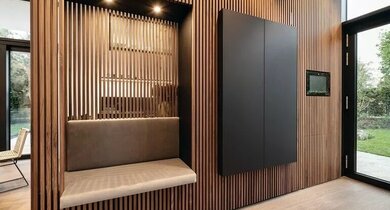
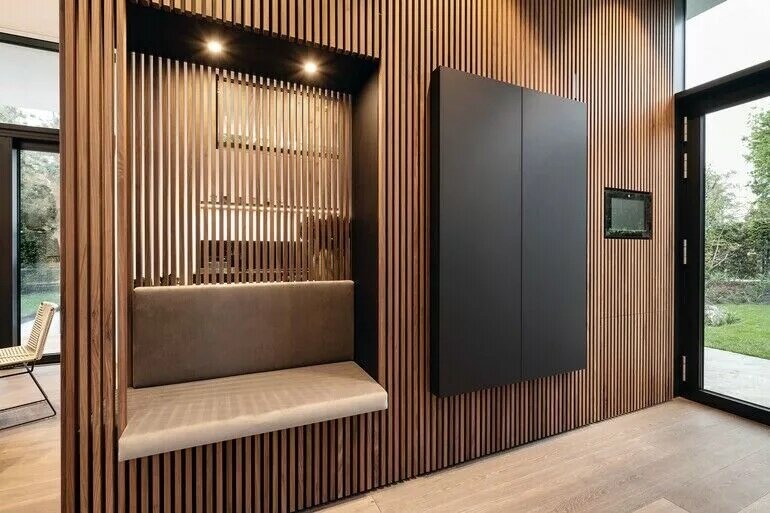
As I walk through the production facility, I notice that I see very little particleboard. There is a lot of blockboard that gets veneered, a lot of solid wood, and many oiled surfaces. "Of course, we do process particleboard here sometimes; there's no getting around it," Greive explains, "but we place a high value on quality and the customer's experience of the products." And if a lacquered finish is required, it has to be a natural wood effect. A four-sided planer, a brushing machine, and an in-house drying kiln are invaluable assets here for processing solid wood.
Herzinger and Greive Design's clientele consists mainly of private customers. In this sector, projects involving complete home fit-outs have become increasingly popular in recent years. However, they also occasionally work on medical practices or shop fittings. The company's service area is 95% within a 30 km radius, but they also have clients in Munich, Vienna, and Salzburg.
Software: From Site Measurement via VR to the CNC
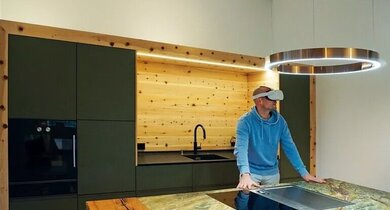
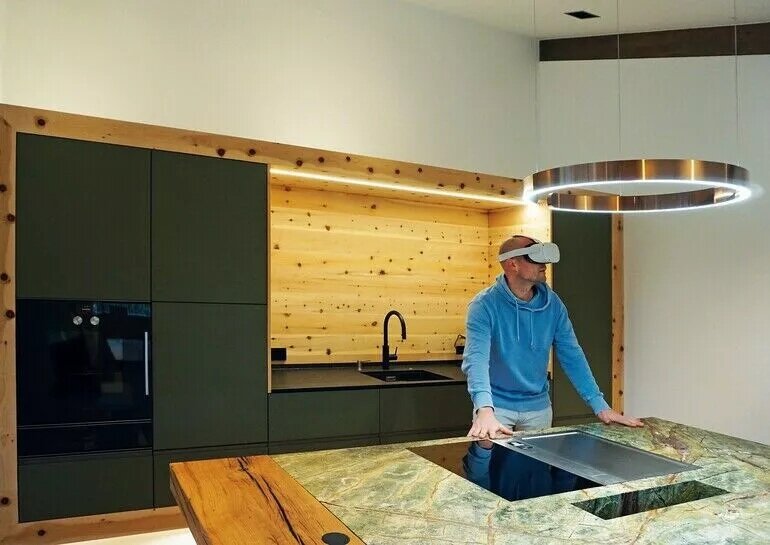
For 3D modeling, the owners rely on Pytha 3D software. "When we decided on Pytha, Toni and I had a one-day training session, and that was it," Andreas Greive recalls with a smile. The switch was brutal, but it was worth it. Since that day, they haven't touched any 2D software. Now, in addition to the two owners, two other employees are responsible for design and production planning. With an initial simple design as a 3D model and a VR headset, Greive wins many clients for the company. "It's just a different experience when you can view the furnishings directly within the room, rather than just on a monitor," the designer emphasizes.
Once a project is commissioned, measurements are taken on-site using the Flexijet 3D. This data forms the basis for the 3D model in Pytha. The parts list is also generated here, which can be seamlessly transferred to Homag's Schnitt Profit software for cutting optimization. For programming, a DXF file is imported from Pytha into WoodWop. Finally, WoodWop creates MPR files for the individual programs.
The delivery of their third CNC is now just around the corner: a Felder Format 4 Profit H80. This machine is intended to handle a series production order for a children's water play feature. "It's a nesting machine with a matrix table," Greive describes. Only for the end-face machining does each component have to be positioned separately. Before that, all parts with the remaining machining operations are routed from the full panel in one go. The three machines will be kept busy, as the Stephanskirchen-based company is also happy to take on complete projects as a subcontractor for colleagues or perform contract milling services, such as for stair stringers.
"25% of Our Time is Spent on Employee Management"
The shortage of skilled workers has not spared Herzinger and Greive. The two owners have been looking for a qualified colleague for the new Felder CNC for some time. In the current climate, it is almost impossible to find good people. They prefer, of course, to train their own apprentices and would like to retain the young journeymen and women. But that, too, is difficult. "Many want to pursue further education or explore other paths," Greive laments. This is despite the attractive conditions the company offers. "Employee management should not be underestimated," the owner points out. "We spend about 25% of our working time on it." They offer above-standard wages, coffee, fuel vouchers, company parties, and employee appraisals. But today, it's not just about monetary benefits. Work-life balance is also a major topic here.
Their online presence certainly plays a role in attracting employees. "We regularly update our Instagram, Facebook, and website," Greive notes. Their external image is important to both owners. It's also a way to attract the attention of new customers.
Exceptional Times and Visions for the Future
The last two years of the COVID pandemic have not harmed the company's order volume. On the contrary. "During this time, people are investing their money in their homes instead of in vacations," explains graduate engineer Greive. Nevertheless, it is difficult to complete all orders in a timely manner. Supply bottlenecks are affecting everyone in the industry, as are COVID-related staff absences. The company is also at full capacity in terms of space. "There's not much more we can do here," explains Greive. "In the near future, we are planning to widen the existing hall by about 100 m². But that would also be the extent of our structural limits."
When Anton Herzinger and Andreas Greive have already reached their 40-hour work week by Wednesday evening and have 60 to 80 hours on the clock by Friday evening, taking a break now and then is worth its weight in gold. "Heading out to the mountains with my daughter for some skiing on a Friday afternoon or a long, active weekend with friends is pure leisure," says the graduate engineer in interior architecture with a sparkle in his eyes.
Finding the balance between work and relaxation is a challenge that Herzinger and Greive have successfully mastered.