






In a 600 m² workshop in Loiching, Lower Bavaria, Michael Kiermeier and his six-person team produce custom interior fittings. This mainly consists of kitchens and furniture for private customers. However, they also create interior furnishings for a major automobile manufacturer, and occasionally, other commercial clients use the woodworking shop's services to give their own workplaces a personal touch. In addition, there is also the contract business, where tenders often involve collaboration with industry colleagues.
Woodworking Shops Born from Dreams and Ambition
Upon my arrival, I went straight through the workshop and into the office. After a brief, warm welcome, Michael Kiermeier emptied a small box of miniature tools onto his desk and said, "let's start from the very beginning." And so we did: As a teenager, Michael Kiermeier began making miniature tools in the woodworking shop where his uncle worked as a journeyman—it was his hobby. This quickly grew into a dream of owning his own shop. With this goal in mind, he began his apprenticeship in a four-person company after finishing school. The work there was still quite traditional; for example, there was no CNC machine. As a newly qualified journeyman, he moved to a company specializing purely in construction joinery. His master craftsman immediately entrusted the furniture maker with his own projects, literally throwing him in at the deep end. "It was tough, but good," he tells me, and he took it as an opportunity to establish a second line of business for the company: from that point on, they also started producing furniture.
To simultaneously take the first steps toward his own woodworking shop, the current company owner started his own business on the side. For this, he set up a small workshop in his parents' basement. This is where he had his first real contact with CNC technology. He acquired a small benchtop CNC machine and began to teach himself the necessary know-how. Shortly thereafter, alongside his job and self-employment, he started attending master craftsman school part-time. Here, for the first time, he had the opportunity to fully indulge his new passion: CNC technology.
With his master craftsman's diploma in hand and technical knowledge under his belt, he turned his dream into reality, bought a plot of land, and built his own woodworking shop from scratch. That was in 2010. After five successful years, which were primarily characterized by installation work, he invested in a through-feed CNC machine and began to manufacture his own products—mainly kitchens. Just three years later, it was replaced by a Format 4 Creator 950. With this, the woodworking shop was equipped for the full range of custom interior fittings and its business really took off.
Custom Furniture Making with Technology that Inspires
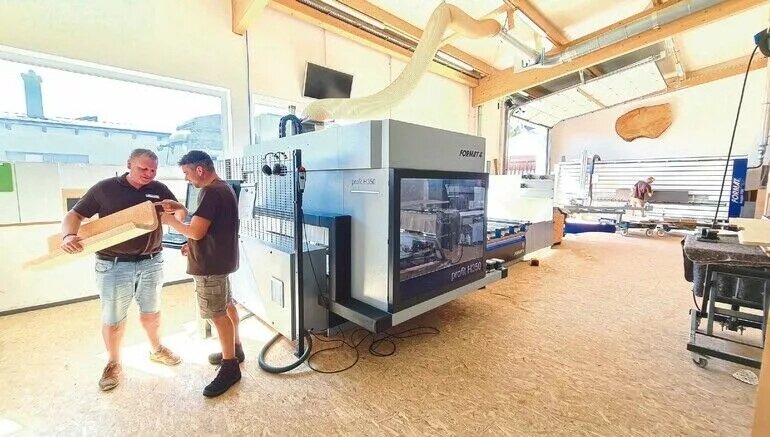
Today, the workshop houses a Format 4 H350 5-axis machining center. It has opened up entirely new design possibilities for the company in the interior fittings business, and they can now also offer molded part and prototype construction. Michael Kiermeier says enthusiastically, "The H350 was one of the best investments of my life. It's like an employee who's never sick." The machine is fully equipped except for an automatic discharge system, i.e., a waste conveyor belt. It has an additional tool changer with 16 positions and an extra sawing unit, which is primarily used for compound miter cuts (i.e., cuts for skewed miters).
The CNC is controlled using data created with the Palette CAD software. The software simultaneously outputs wood and hardware lists. The CNC-relevant data is transferred to the machining center via a USB stick and processed directly at the terminal in Felder's proprietary CAD/CAM software, F4 Create. The master joiner finds the visualization of the milling processes particularly well done and tells me that, thanks to the intuitive operation and his prior knowledge, he didn't even need any training to operate the CNC machining center and its software.
For panel cutting, there is also a panel saw and a sliding table saw, also in the distinctive blue color. In addition, there is a jointer, a thickness planer, and a long-belt sander in classic green. If a wide-belt sander is ever needed, their strong network allows them to have larger sanding jobs done at a partner woodworking shop.
Edgebanding Technology for High-Quality Interior Fittings
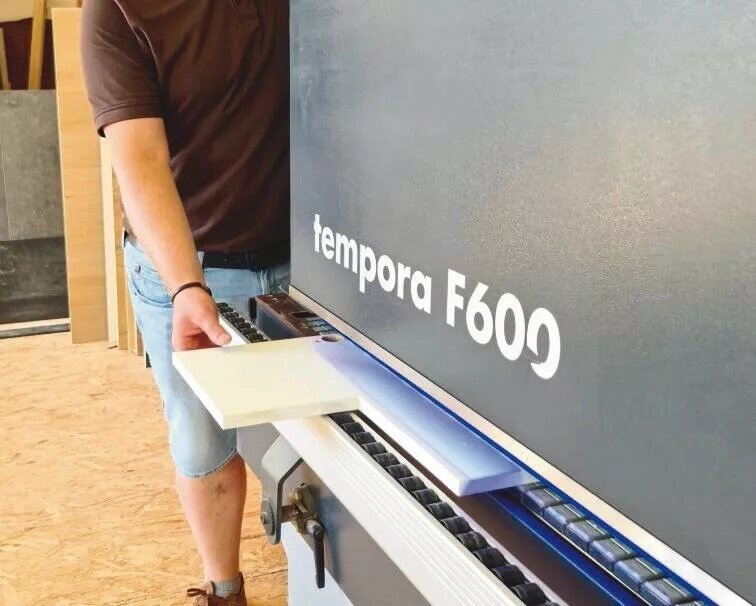
A few weeks ago, a new Format 4 Tempora F600 edgebanding machine was added. It already has over 3,000 linear meters on the clock, as Kiermeier's woodworking shop also offers contract edgebanding services for colleagues. "The machine achieves such a good result, and we want our colleagues to benefit from it too," the owner tells me. It can be run with either EVA adhesive or the innovative PUR adhesive from a roll. The GlueBox system applies a thin strip of PUR adhesive from a roll between the edge and the workpiece, fusing the two components together. The heat activation of the adhesive ensures optimal adhesion and bonding strength. This technology makes a glue pot and the associated maintenance obsolete.
The Most Beautiful Way to Travel
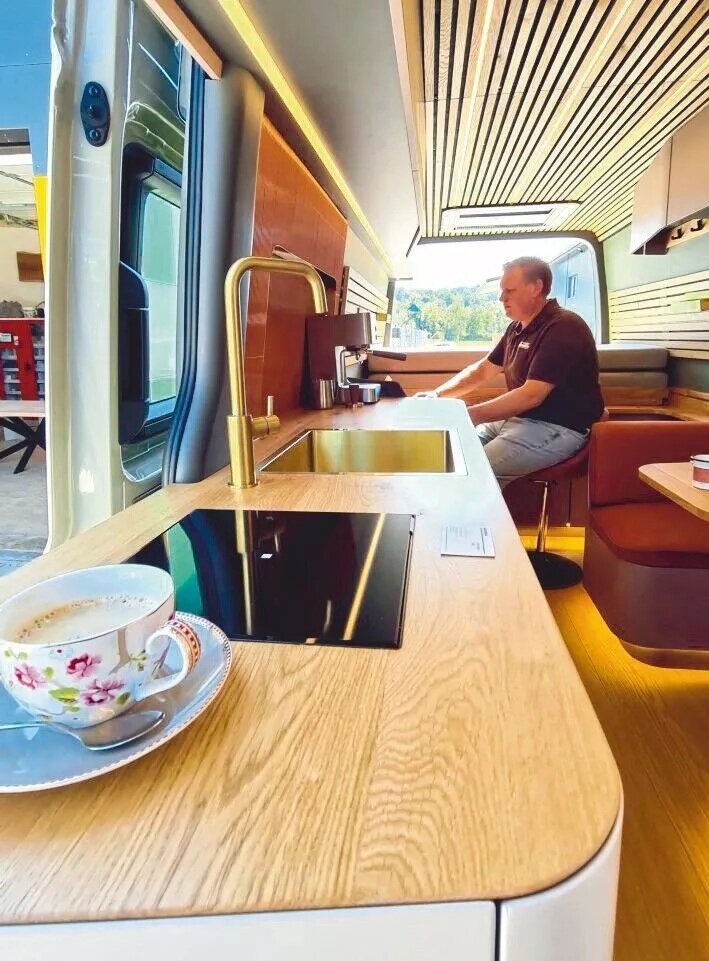
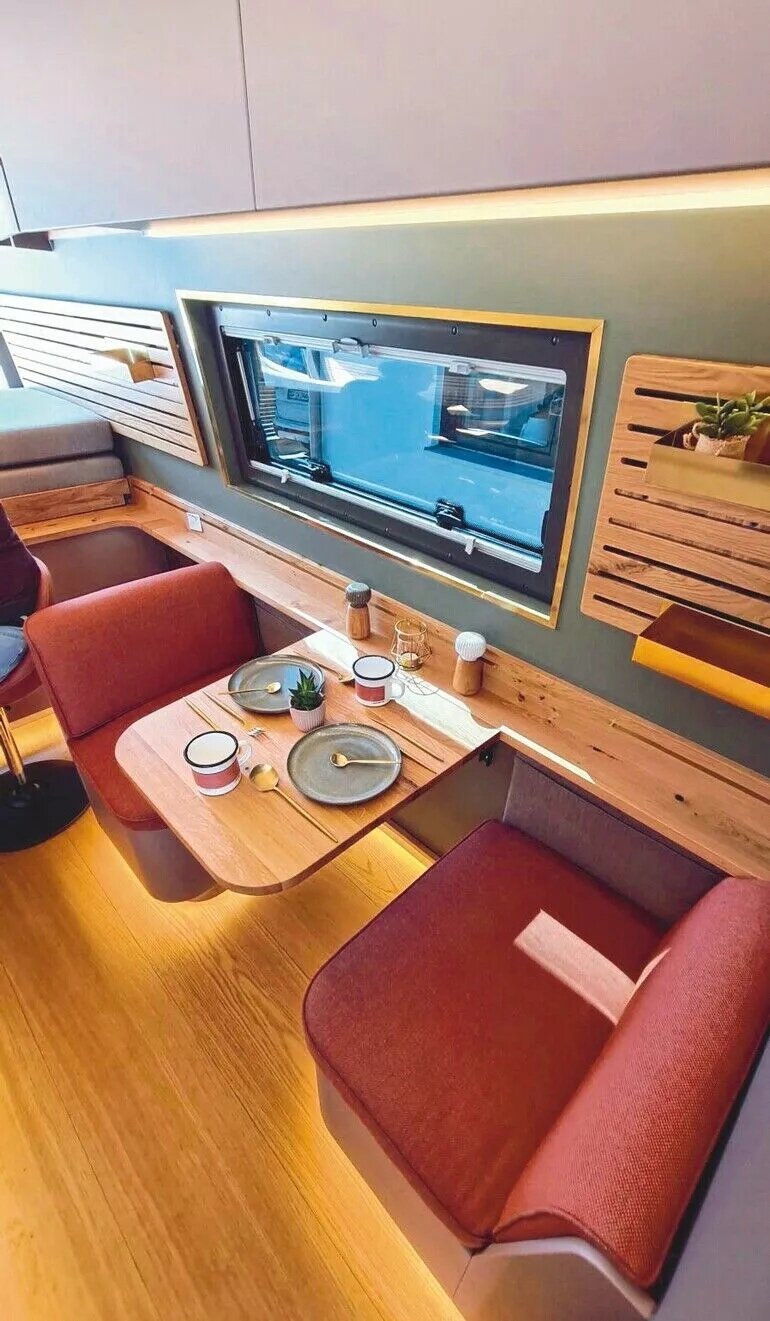
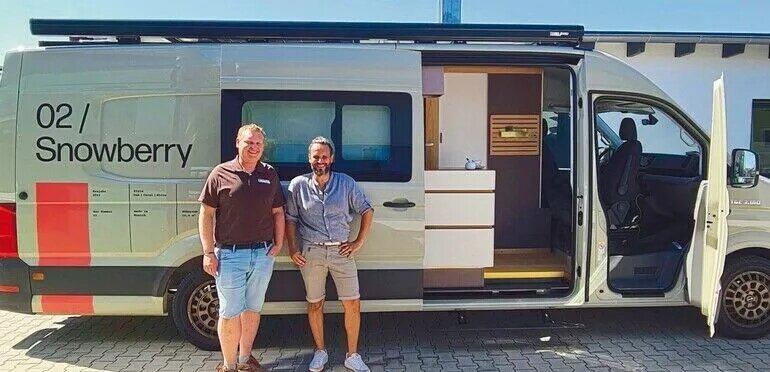
In addition to custom, one-of-a-kind pieces, the woodworking shop will soon also be producing small series. After Michael Kiermeier privately converted and fitted out an expedition vehicle with a demountable container for himself and his family in 2022, Sebastian Wilk approached him with the idea of a tiny house on wheels. The LaybackBus project found a receptive audience in the master joiner, who promptly decided to co-design the interior fit-out—especially concerning the technical implementation. The basic idea: a mobile vehicle for anyone for whom a California is too small, a self-built camper van is too much effort, and a motorhome isn't elegant enough. The base is an extra-long MAN TGE with a high roof, which is available in four stylish color and material concepts.
After extensive development work on design, business model, etc., Sebastian Wilk and Michael Kiermeier have optimized the interior of the LaybackBus over the past year to the point where they can soon start series production. The plan is to produce 25 units in 2025. While a lot of tinkering and optimization was done on the physical prototype during development, much of it was also created directly on the PC. For seamless planning, the master joiner received DXF data that he could further process in Palette CAD. This often involved details and fulfilling Sebastian Wilk's well-thought-out but not-so-simple wishes. For the implementation, the master joiner always worked directly with 3D drawings. Once a piece was fully designed, it was produced—either going directly from panel cutting to the CNC or with an intermediate stop at the VPR 3000 vacuum press from Istra. This press is also frequently used for custom interior fittings and has been with the company for many years. The same goes for the Multi Press from Barth. All cabinet furniture, mostly kitchen cabinets, can be clamped and processed here. For example, fittings are mounted directly at the press. This avoids moving the workpiece and allows for assembly at a comfortable working height.
Customer Acquisition Made Easy
The woodworking shop has a very clear process for its customers: After the initial consultation, a 2D drawing is created. If the customer is satisfied with the design, they receive the 3D drawing along with the order confirmation. Then, the product is manufactured and installed. As a nice extra, many customers receive a small, handmade gift after the final acceptance, which, according to Michael Kiermeier, often creates a good feeling and leads to repeat business. For customer acquisition, he relies on social media ads on Facebook and Instagram. He invests about 50 euros a month, and it pays off: "We win 75% of our new customers through these ads. It's quite simple; you just have to familiarize yourself with the workflow once, and then you can start running ads," the owner explains.
Satisfied and Forward-Thinking
He doesn't wish for much for the future, because things are good as they are right now. However, he hopes that our profession, and craftsmanship in general, will receive more recognition in society. "If craftsmanship is seen as valuable by the general public, we will continue to attract good apprentices to whom we can pass on our passion and solve tricky challenges together."
In the near future, there will be new investments: an ERP system for more seamless integration and a new sliding table saw with a safety system are planned to arrive soon.


