






Rudi Geitner, a journeyman at the Pappenheimer joinery in Hilpoltstein, Franconia, is producing interior doors that are to be painted white. He has already produced the blanks. Now it's time for CNC machining. The control computer for the 5-axis CNC "Profit H350" from Format4, which was purchased a year ago, is joined by a second one for any other company applications. Data can be exchanged via drag-and-drop. The programming system "F4Integrate" is currently running on the left one. The joiner calls up the program for doors with a single rabbet. A table appears on the screen, into which he enters the desired dimensions and light cutouts. He can also select numerous options, such as DIN left or right, a third hinge, a bit key lock or a cylinder lock. He programmed this program himself, as well as those for all other types of interior doors.
A Simple Solution for Interior Doors
This took several months. Now he and all his colleagues can produce almost any conceivable variant of an interior door simply by entering a few parameters. The parameters for the current door are entered in just a few seconds. Based on the entries, the programming system generates the actual CNC program, including the positioning specifications for the console tables and vacuum pods. The screen displays the target positions of all console tables and vacuum pods as well as the workpiece and the positioning stops. Rudi Geitner takes in the approximate arrangement at a glance, goes to the machine table, and sets up the specified table layout. He doesn't even need to know the coordinates of the individual elements; LED light strips indicate the target positions. The layout is correct, so Rudi Geitner raises the HPL lifting rails and the positioning stops.
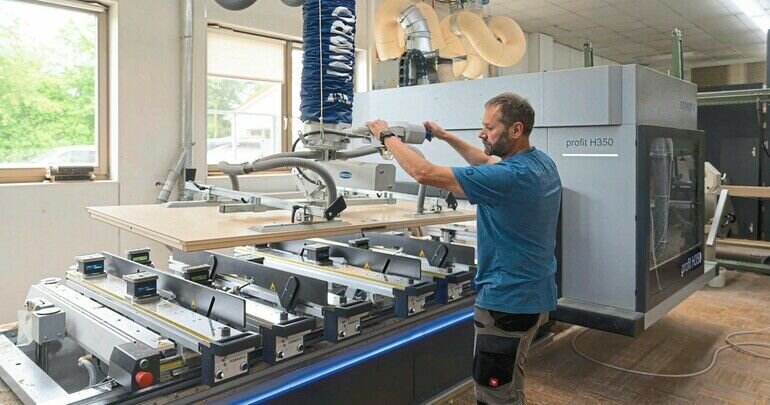
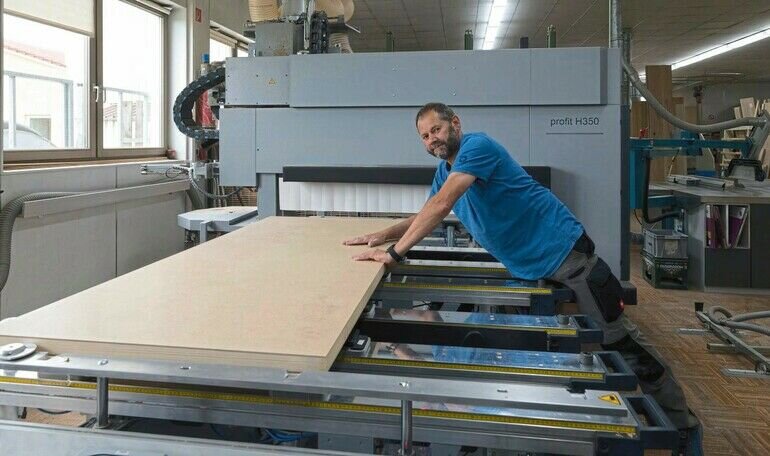
Using a vacuum lifter, he picks up the door leaf blank standing vertically in the order picking cart and places it on the CNC Profit H350. He releases the vacuum at the touch of a button and returns the lifting aid to its park position. On the HPL lifting rails, he slides the blank against the rear and one side stop, lowers the lifting rails, activates the vacuum clamps, and starts the program. After about five minutes, the door leaf is sized, profiled all around, and provided with all drillings and routings. The door is moved to the cart for the bench room using the vacuum lifter.
CAD/CAM for Furniture
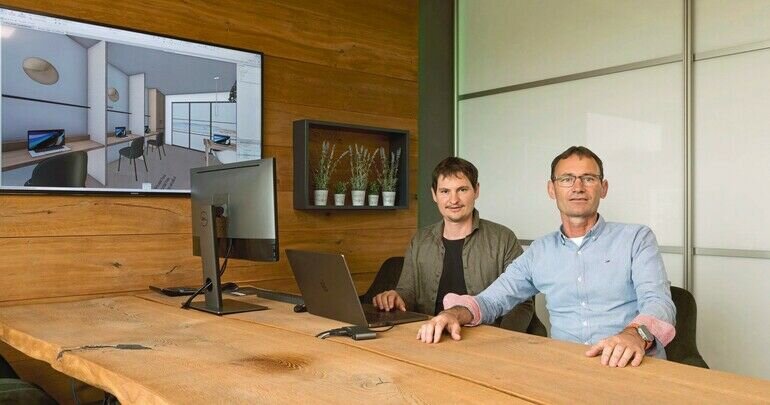
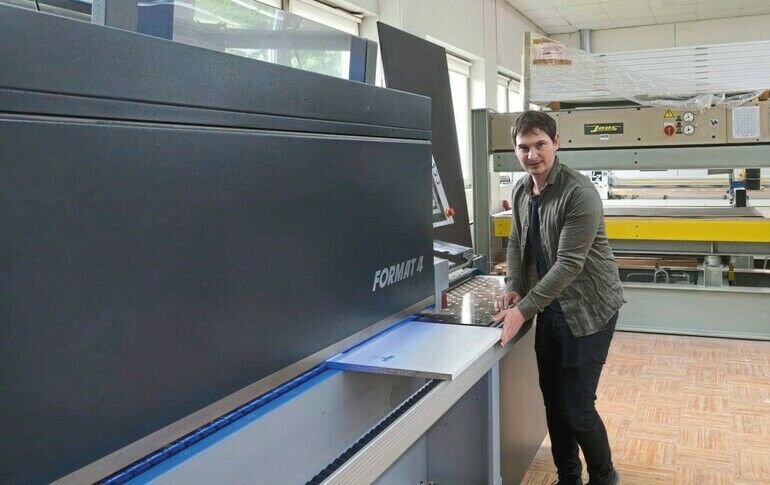
The Profit H350 has processed all the doors; now it's time for the white built-in cabinet. Matthias Pappenheimer, a master joiner and graduate of the Garmisch-Partenkirchen Academy for Interior and Object Design, first planned and visualized it with Vectorworks. Then his father, company owner Ewald Pappenheimer, created the quote using the industry software OSD. After the order confirmation was received, it was Matthias's turn again. He designed the cabinet with the CAD/CAM system TopSolid Wood, generated parts lists, cutting plans, and CNC programs, ordered all materials, and sent the job to the workshop. The cutting to size and edge banding on the Tempora F800 edge banding machine from Format4 have already been completed. The set of parts is on a cart next to the CNC. Rudi Geitner takes the first part, scans the barcode label, and the CNC program immediately appears on the F4Integrate screen. This allows him to process one part after another quickly.
OneNote Answers Questions
The phone rings. The customer reports a change request: a hole in the right side panel for the Wi-Fi socket in the room's niche. Rudi Geitner says: "Yes, no problem!", opens the OneNote cloud, which is organized by jobs, on the right-hand screen, finds the photos taken during the site measurement with all the necessary dimensions, and transfers the exact positional coordinates for the socket hole into the F4Integrate program. He would make more complex changes in TopSolid Wood. This software also runs at the machine, so he can save himself the trip to the office.
Doors, Furniture, Kitchen Studio
Pappenheimer employs twelve people, six of whom work in the 1000 m² workshop. A major revenue driver is the kitchen studio, which operates as a retail business with its own separate data environment. The joinery produces doors and furniture for private customers.
The CNC is the Linchpin
Ewald Pappenheimer says: "We are very keen on digitalization and rely completely on the 5-axis CNC H350. It has not disappointed us and fits perfectly into our rather complex data structure."


