






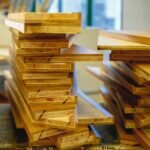
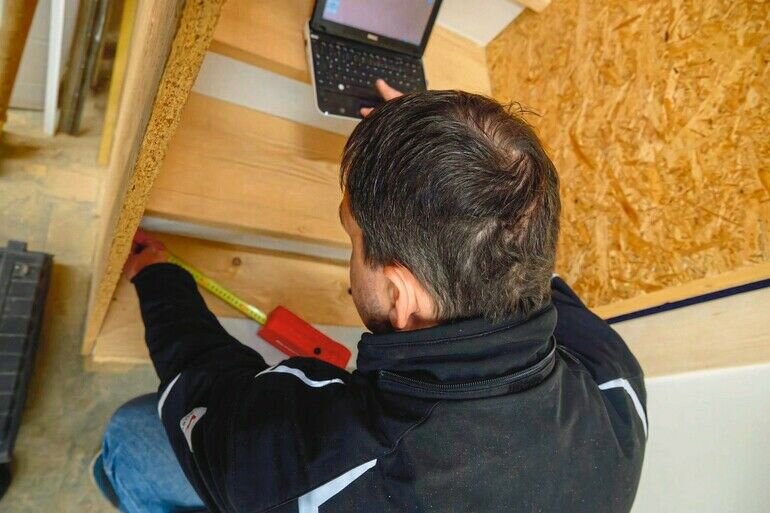
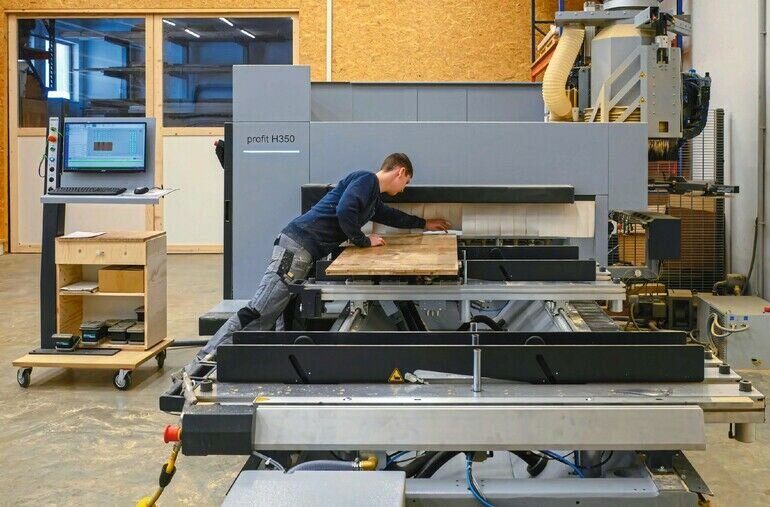
Journeyman carpenter Lukas Seidl is producing wooden treads for a winder staircase at the Herbert Ruhland carpentry shop in Pemfling, Lower Bavaria. These are to be installed on a concrete stair core permanently built into the building. He no longer performs the tasks crucial for precision and efficiency on the sliding table saw, but on the “Profit H350” 5-axis machining center from Format4, which was purchased almost a year ago.
From Site Survey to Production
His boss, managing director and master carpenter Herbert Ruhland, previously measured the contour of each individual tread on the construction site using the “Stairbox” stair tread measuring system. He then used the Palette CAD/CAM system to process them into closed polygons, created a solid body from this with a 45° miter on the tread nosing, and had the corresponding CNC programs generated via the CAM module. Two winder treads at a time can be produced from one rectangle in a material-saving way by nesting them opposite each other. With this in mind, he then formed pairs from the treads, determined the respective size of the rectangles to be produced in the first step, and positioned the separating cut.
Thick Treads from Pre-finished Parquet
Using the list of rectangles, Lukas Seidl prepares the material: pre-lacquered, three-layer parquet and blockboard, supplied by the client, a flooring contractor. He cuts the parquet and the boards to the format of the rectangles and glues them together in the veneer press. For the tread nosings, he creates sandwich strips, which he edges on both long sides.
Lukas Seidl calls up the first program for the separating cut on the CNC. He first places the consoles and vacuum pods virtually on the screen and then replicates the layout on the machine table. To do this, he uses the grid of vacuum valves on the consoles, which is faster than using the laser projector on the gantry. Once set, he only has to make minor adjustments to the vacuum pod layout in between. All separating cuts are sawn. This is followed by sawing the contour and the miter on the treads, as well as sawing the miters on the strips.
More Efficient, Faster, Better
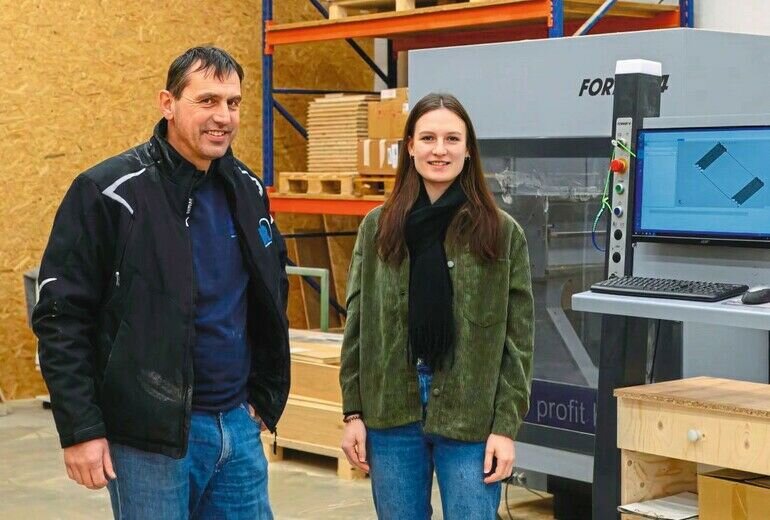
Herbert Ruhland founded his carpentry shop in 1997 and today runs it together with his daughter, master carpenter Laura Ruhland. The company employs five journeymen. A year ago, the two decided to switch the business to CNC. With CAD/CAM, they wanted to work more efficiently and faster both in the office and in the workshop, and also improve the machining quality. The mainstays of the business are furniture and interior finishing, commercial projects, as well as wooden treads for concrete stairs in cooperation with flooring contractors.
Herbert Ruhland says: “With the H350, we work more efficiently, faster, and more precisely. The quality we achieve with miter cuts is impressive, something we had never achieved on the sliding table saw before.”


