






In 1993, Ivan Zezelj and one employee opened a small joinery shop in the west of Stuttgart. A year later, his son Denis Zezelj, a journeyman at the time and now the owner and a master craftsman, jumped on board the family enterprise. Back then, it was still running with just a few used, standard machines. Despite the rather sparse equipment and the cramped space of about 60 m², this is where they created "Custom Furniture to Fall in Love With." And that is precisely the company's motto once again today!
A lot has happened in the nearly 30 years since. During our on-site visit in early January, Denis Zezelj recounted the company's journey, with all its ups and downs. On our initial tour of the workshop, we immediately noticed that there were no old machines left, not even as a curiosity. But for him, it is clear that his company is on a path where clearing things out is essential. This is despite the fact that he would have loved to show his customers the wooden edgebander he worked with in the 90s, which he regrets having given away a few years ago. Clearing out, structuring, simplifying workflows, and optimizing processes have been a major part of the company philosophy for several years now—even if it means a rare piece disappears.
Tales from Swabia
Three years after opening, the joinery expanded with new premises in Tamm, near Stuttgart, growing from 60 to 250 m² and from three to eight employees. They produced custom furniture, kitchens, and wall units, as well as windows and doors. During this time, Denis Zezelj was earning his master craftsman's certificate at night school.
"Now we're really taking off," was the motto in 2004. With the purchase of a 5000 m² section of an industrial building in Remseck am Neckar, suddenly there was nearly 20 times more space available. This meant there were almost no limits to further growth and the realization of new ideas. The joinery expanded its range of services to become a full-service provider—from planning and carpentry to drywall, plumbing, electrical work, and individual furnishings.
The first CNC machine also found its way into the workshop: a Format 4 Profit 2S. The Truncad carcass generator was available as a CAD program, and Genesis was used as the CNC software. On top of that, the Zezeljs opened a retail store and showroom in downtown Stuttgart. The company also maintained nearly 20 different warehouses in the surrounding area to store all the materials for the various trades.
By 2016, the company had grown to over 30 employees, and Denis Zezelj, by then the sole managing director, decided: "We need orderly structures and want to get back to our roots. Our passion is 'furniture to fall in love with,' so that should be our core business again!"
Back to the Roots: A Passion for the Craft
The self-imposed agenda for this transformation included many points, such as closing the store in downtown Stuttgart, decoupling the various trade segments, and consolidating the 20 warehouses. Optimizing the entire workflow in the joinery turned out to be a lengthy process, all with a view to the future core business: "Custom Furniture to Fall in Love With."
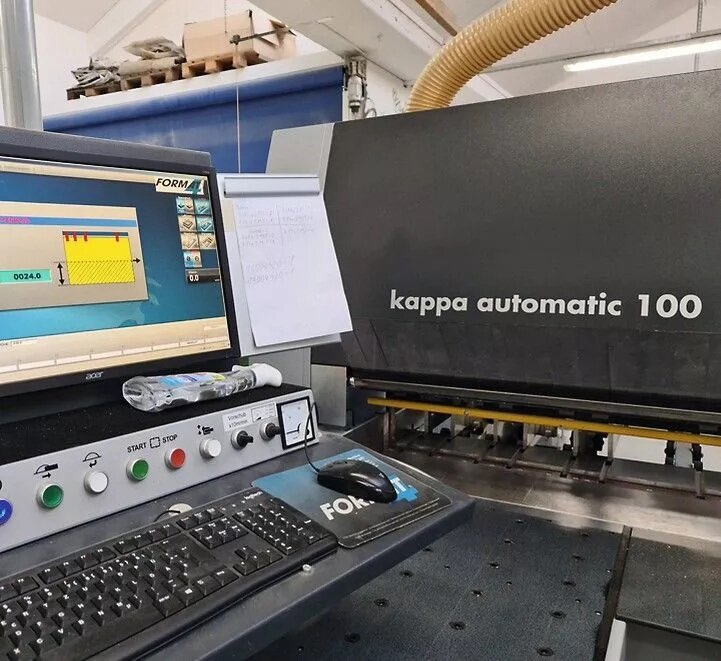
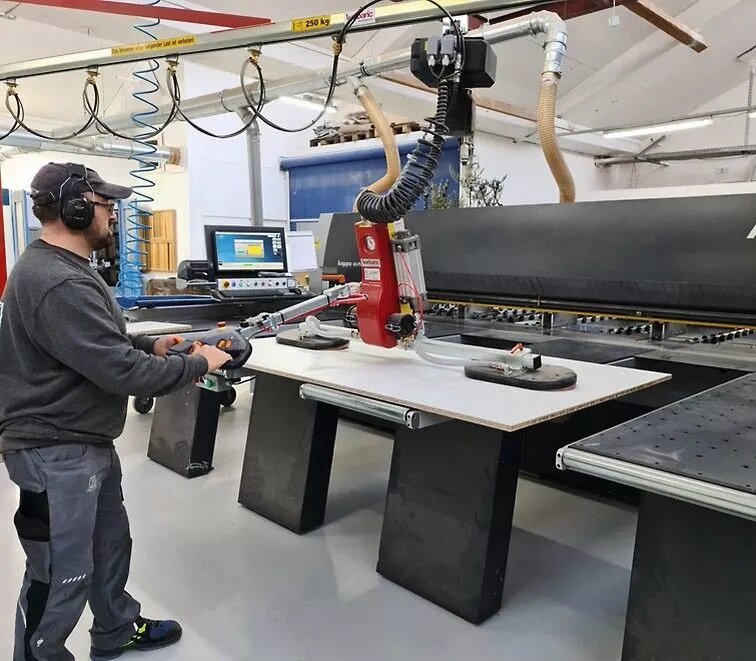
Following initial tips on operational optimization from guild colleagues, the panel processing workflow was switched from vertical to horizontal—both in storage and at the saw. To this end, the company purchased the Kappa Automatic 100 horizontal panel saw in 2017, including the Ardis cutting optimization software. Today, it stands directly opposite the new CNC machine and can be loaded and unloaded via forklift and a Barbaric lift-and-swivel device.
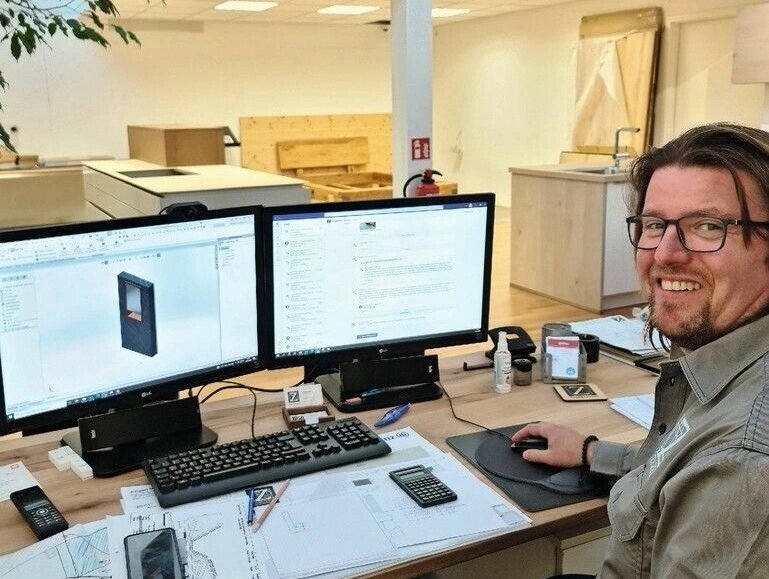
Logically, after panel cutting, the parts go to the CNC machine. The CAD planning precedes this processing step. Therefore, a new CAD program was the first thing on the list. During his search, Zezelj quickly realized that he needed professional help to avoid wasting unnecessary time and money. He turned to AV-Line, a company specializing in process optimization with a focus on CAD/CAM in joineries. The contact was made through the Meisterteam cooperative group, which the master craftsman had joined to have his business certified according to PEFC and FSC standards.
After an on-site visit from AV-Line and a subsequent report, however, it wasn't just a simple matter of selecting a CAD program. A plan for operational optimization was created for the entire company. The optimization experts, together with Denis Zezelj and his employees, developed a five-year plan for the joinery. A major focus was on creating a digitalized and seamless workflow—from the initial customer contact through planning and production to invoicing.
Five Years of Operational Optimization Starts with Major Investments
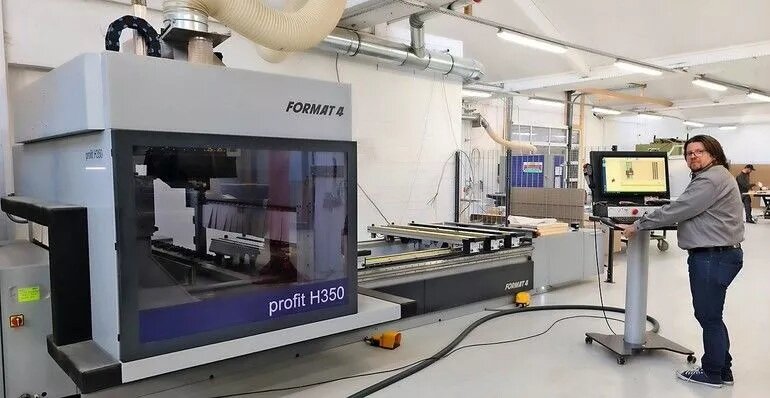
To begin, they immediately tackled the topic of CAD/CAM and CNC, investing in both software and hardware. Since 2019, the joinery has been using the Solidworks CAD program with Swood as a CAM add-on. This is complemented by a Format 4 Profit H350 CNC machine from Felder. "The 5-axis machine is a perfect fit for us. With it, we can produce everything in batch size 1. The machine also provides enough tool stations for our needs, and with the small nesting attachment (approx. 125 x 62 cm) that Felder provided, we can also produce small parts without any problems."
Mid-Term in Operational Optimization: From Drawing to Edge
We're now at the halfway point! Two and a half years have passed since the start of the five-year plan, and a lot has happened at the joinery; many processes have been optimized: The production area—the workshop—has been completely reorganized. Network cables, distributed throughout the workshop via cable trays, connect all machines and workstations. In addition, the machines have been rearranged to facilitate the production flow. Handling equipment ensures that all tasks can be performed by one person.
The production planning department sends order data via network cable to the panel saw and the CNC machine. After cutting, each part receives a barcode, which is printed at the panel saw. Before a workpiece is placed on the 5-axis machine, the barcode is scanned, and the machine automatically knows which program it needs. Once processing is complete, the workpieces make a brief stop at the edgebander. Then it's on to assembly.
At Zezelj, every finished product is assembled once in the workshop. This has two advantages: first, it helps to avoid unpleasant customer complaints, and second, the assembled furniture is ready to be photographed. The clever part: An online shop is planned for the future, where previously produced furniture will be offered directly with a price. "After all, any piece of furniture that is planned from end to end can be easily reproduced," says the owner.
Mid-Term in Operational Optimization: Organization and Assembly
But even more has changed in the midst of the five-year plan:
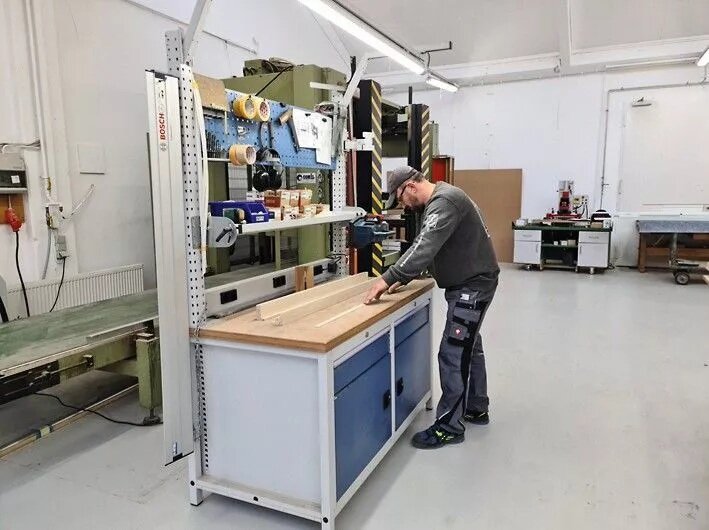
- Only mobile workbenches are now available. The exception: two traditional workbenches that the apprentices use for practice. Well-organized, everyone has the opportunity to position their workbench wherever they need it. It also makes it easy to create space to set up a large kitchen for a photoshoot.
- Downsizing: The 20 warehouses have been reduced to three. These still hold solid wood, which, like the warehouses themselves, is gradually dwindling. The joinery now stores materials on a per-job basis. Three storage options are available for this: pallets, small parts, and long parts. Additionally, there is a horizontal panel storage area located right next to the panel saw, which is operated by forklift.
- In an operational optimization, everyone has to be on board: For this reason, every employee now has the same, and most importantly, their own personal tools, which they can store and lock in their tool trolley—no one else has a key.
- Communication has also changed, as Denis Zezelj describes: "Everyone here has a company mobile phone, which offers several advantages. First, we use Microsoft Teams for communication, which also allows us to share files and information. For example, I document every site measurement with pictures and videos that everyone can access. This prevents misunderstandings and errors."
- As part of the five-year plan, company meetings were also introduced. Four times a year, all employees, including the owner, exchange ideas openly and in a solution-oriented manner.
Sailing Ambitiously into the Future
The "steamer" created almost 30 years ago has certainly become a handsome and, above all, modern joinery. To stay true to the metaphor: it is now a catamaran packed with electronics, on course towards its new destination with its captain and nearly 20 employees: the implementation of the five-year operational optimization plan.
For the near and distant future, some goals are already set, while others are yet to be defined. In the near future, for example, is the new Format 4 Tempora F800 edgebander, which arrived shortly after our visit, or the second CAD workstation that is currently being set up. Further in the future is the big trip: Denis Zezelj wants to set up his business by 2026 in such a way that he can embark on a year-long journey to visit joineries all over the world.
We will definitely be following their story and are excited to see what the future holds.


