

As soon as I enter the Prewo Joinery, I can hear the hum of machines from the ground-floor workshop through the door in the stairwell. One floor up is the showroom with adjoining offices. There, I am warmly welcomed by the owner, Miriam Prewo.
Innovation with deep roots
As we begin our tour, she tells me that the joinery was founded over 110 years ago by Eugen Prewo, and that she has been managing the company in its fourth generation since 2012. "Competence and experience are essential and valuable building blocks in an owner-managed family business, but it quickly became clear to me that simply continuing as before was not an option," Miriam Prewo summarizes.
Nothing is as constant as change
To remain competitive, the continuous development of all processes is crucial. This aspiration is now deeply embedded in the company's structures and is reflected in many examples I discovered during my tour. In addition to a network of intelligent machines, the company also uses custom-programmed industry software and a self-developed app for resource and capacity planning.
Miriam Prewo explains with a few more examples that the innovations are not limited to production alone. The joinery uses digital project time tracking, automated time accounts, and a digital approval system for supplier invoices.
Furthermore, the company sources some of its electricity from its own photovoltaic system and generates heat from wood waste. The commitment to reducing its own carbon footprint is also evident in the selection of wood and tool suppliers: The focus here is on sourcing as locally as possible.
Interior Design Office and Joinery
Miriam Prewo describes the combination of a design office and in-house production as a "perfect match." As an interior designer and a joiner, she combines both worlds and brings her expertise to consultations and client meetings. She uses live 3D planning to visualize design drafts, helping clients to specify their wishes. In her designs, she places great importance on both optimizing the use of space and considering the individual needs of her clients—whether for individual pieces of furniture or a complete interior fit-out. She designs not only for private apartments and houses but also for medical practices, law firms, and companies. If required, Miriam Prewo also takes on construction management for cross-trade coordination.
Interface Workflow
Miriam Prewo creates the aforementioned visualizations with Palette CAD. From this, the operations manager, Hans-Georg Paepcke, then generates the corresponding construction drawings in production planning and creates all relevant data for production using intelligent bills of materials.
The data is sent directly to all machines over the network in their respective G-code language. Every part on the bill of materials has its own digital ID, which can be called up on any machine.
Consistently Simplifying Machine Loading
The panel storage area is modest, as materials are usually ordered just-in-time on a per-job basis, as far as this is possible despite current supply bottlenecks and raw material shortages.
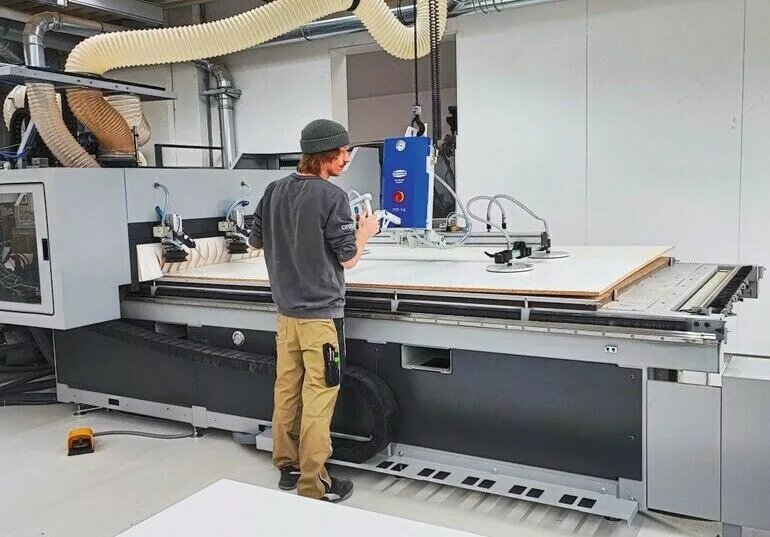
The machines are loaded with material using a Schmalz crane system with a vacuum lifting device. With specially designed running rails, it allows all machines to be reached ergonomically.
At this point, Miriam Prewo tells us about another vision: loading the nesting machine at the push of a button. The machine has been prepared for this ex-works by Felder. However, an extension to the building is still needed, which is already in the planning phase.
From Panel to Individual Component
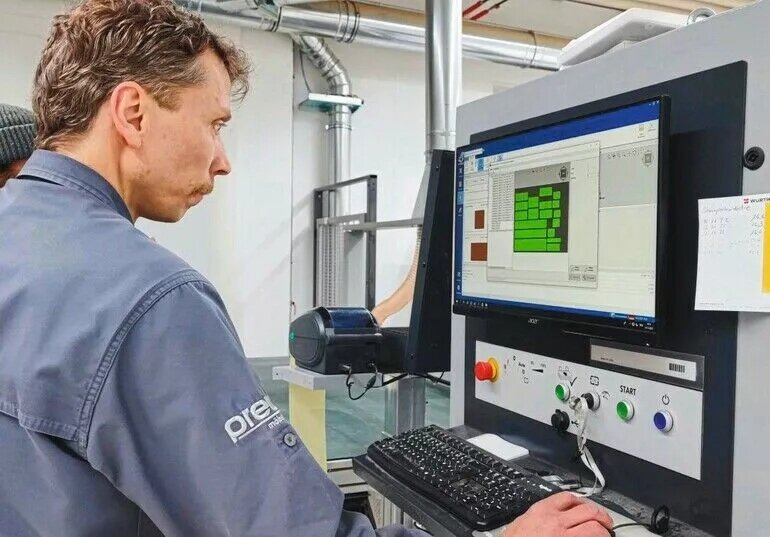
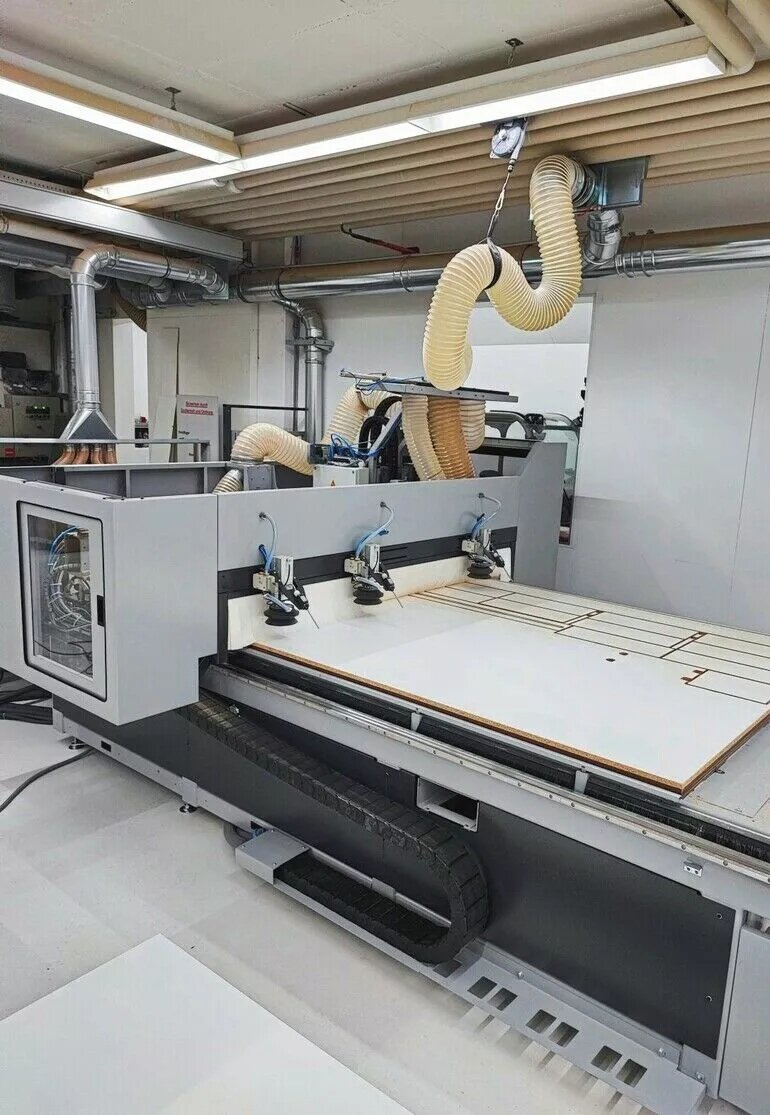
Once the digital job has arrived at the Format 4 Profit H80 nesting machine or its F4Integrate software, the data can be retrieved via the F4Create CAD/CAM module and adjusted if necessary. The F4Nest software module offers cutting optimization, which can also be changed manually at the control terminal. The machine is then controlled and operated via the F4Operate module.
For processing, the panel is positioned on the machine table using the positioning cylinders. The Profit H80's Smart-Zoning-Vacuum-System then automatically detects the workpiece size and ensures that both full panels and small components are securely fixed to the worktable without slipping.
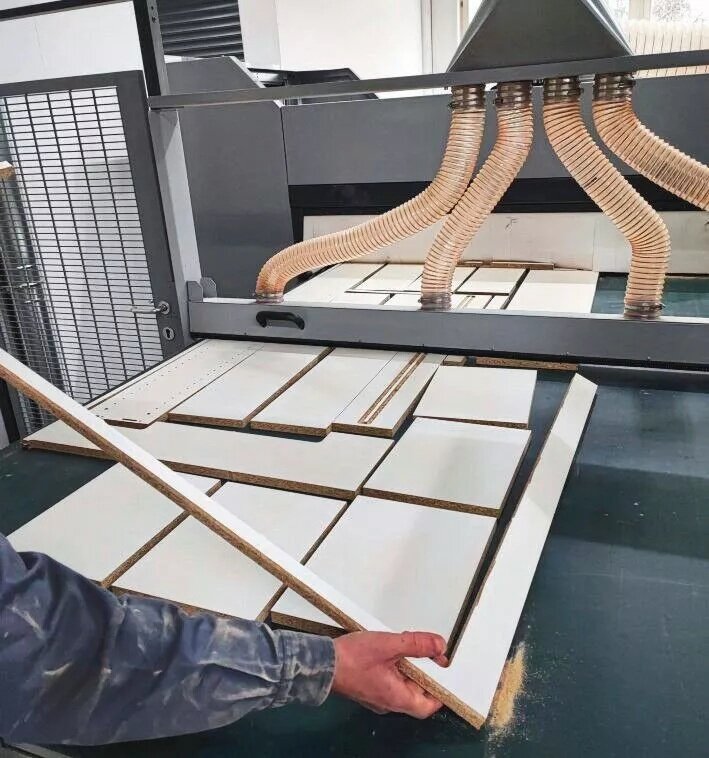
The routing program can now run. Afterwards, the pusher unit and the conveyor belt automatically move the finished routed components to the unloading table, which ensures a continuous routing process.
Making Workpieces Traceable
The overhead extraction on the pusher unit cleans the surface of the workpieces during removal. This improves the adhesion of the labels that are applied afterwards. For this purpose, there is an additional operating terminal with an integrated thermal label printer at the unloading table. The 24-inch monitor also shows the position and rotation of the labels, which facilitates manual labeling.
From the Edge to the Customer
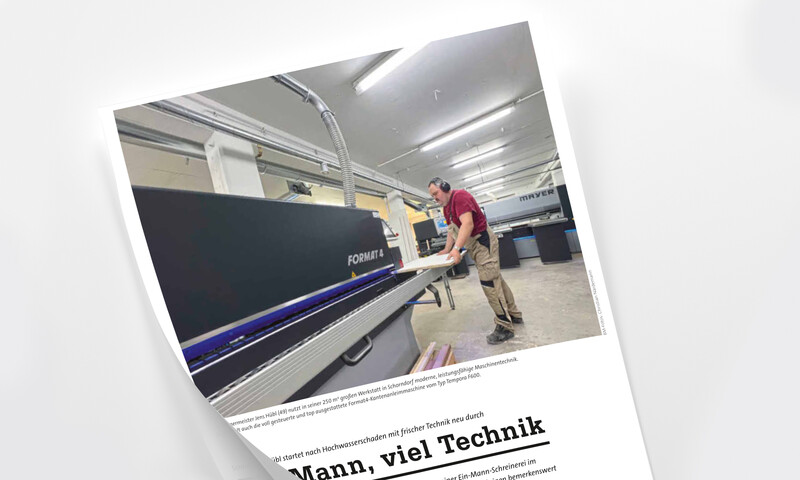
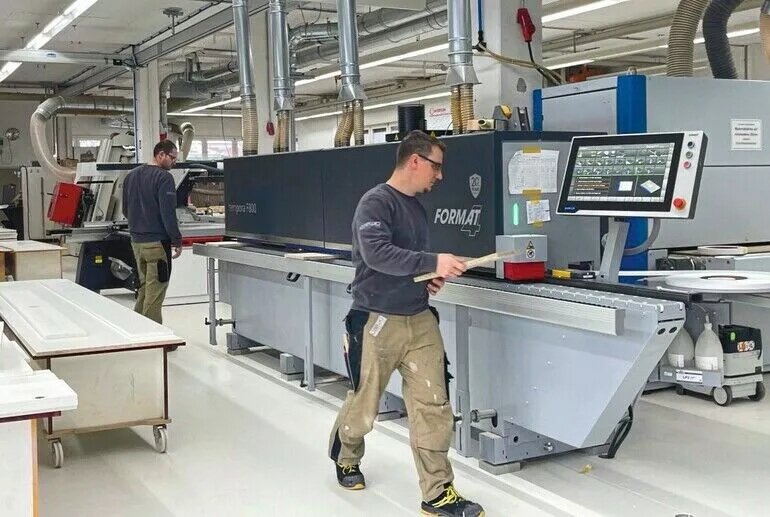
While the nesting machine processes the next panel independently without manpower, the responsible employee feeds the already labeled workpieces through the Tempora F800 edgebander, whose AdvantEdge gluing unit enables a zero-joint look for co-extruded edges.
Afterwards, only those workpieces that require machining on the back or drilling/routing through the previously applied edge need to go to the CNC machining center. For this, two vertical 4-axis Scheer BC2001 CNCs are available, which can be operated by the entire team. "That's part of our philosophy," explains operations manager Hans-Georg Paepcke. "Everyone manages their job from A to Z—right through to delivery and installation at the customer's site."
New Machine, New Connector
With the switch to the nesting machine, the question of which type of furniture connector to use also arose. Hans-Georg Paepcke and Miriam Prewo opted for the FixChip and are completely convinced by it. This is because the individual components can be arranged closer together on the panel, resulting in a greater yield and fewer offcuts. What's more, the connector is made of recycled HDF and is also inexpensive to purchase.
Step by Step into the Future
In the long term, the two Scheer machining centers are to be replaced by a horizontal 5-axis CNC machine and a through-feed CNC. But changing entire production processes takes time and is done step by step. "For a successful implementation, one component is crucial besides the technology: the team!" emphasize owner Miriam Prewo and operations manager Hans-Georg Paepcke. And they can count on them: The entire team contributes with expertise, passion, and an openness to innovation. Finally, Miriam Prewo shows us the "info and motivation board": Here, all employees can view important information daily. Customer feedback is also part of the board. "This feedback is extremely important for the development of the team and our processes. The principle is: Successes are celebrated, and when there's critical feedback, no one is ever singled out for blame. That motivates us, and we learn from it," says Miriam Prewo.
So, a lot is changing at the joinery to ensure it remains well-positioned for the future of woodworking.